
Intent
What problem does this pattern solve?
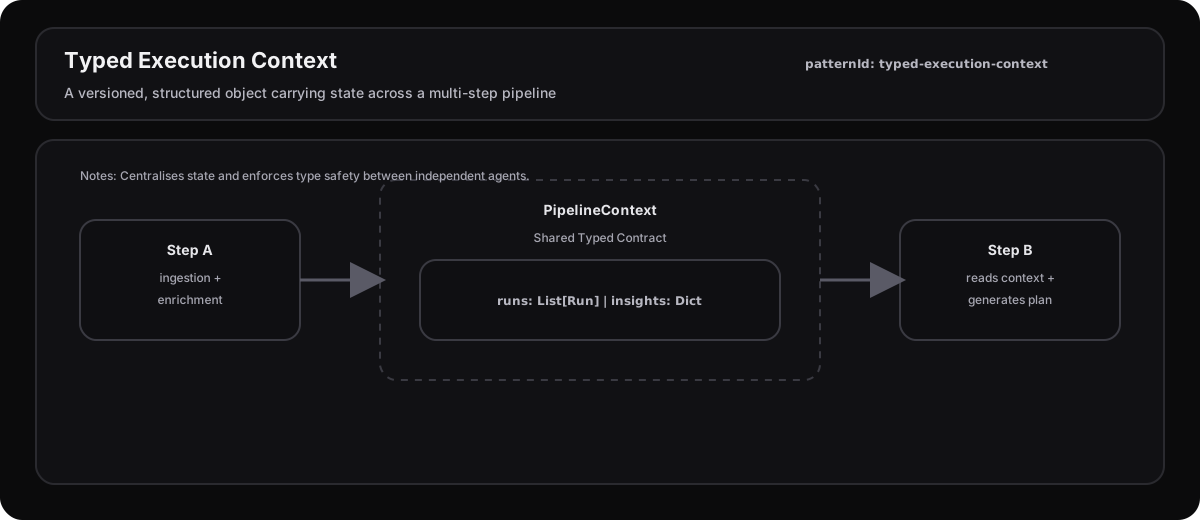
It eliminates “string-keyed dictionary” or “dynamic attribute” anti-patterns where pipeline steps depend on invisible or inconsistently defined state. It ensures that inputs, intermediate results, and outputs are discoverable and type-safe across a multi-agent orchestration flow.
Context
When and where does this pattern appear?
This pattern emerged in the Runner Agentic Intelligence system to manage the high-pressure transition of raw athletic data (FIT/GPX) through multiple processing layers: feature engineering, positioning, intelligence generation, and visualization. It appears in systems where state is progressively enriched by specialized agents or computational engines.
Agentic profile
Describe the agentic architecture shape explicitly.
- System shape: multi-agent
- Orchestration mode: sequential
Agent-to-agent interaction
- Present: true
- Mechanism: shared-state
- Evidence: PipelineContext
Tool protocols
- MCP: absent
- Tool calling: present
- Evidence: Insights Generation (LLM with schema)
Optimisation target
- Primary: reliability
- Secondary: safety, developer-velocity
- Notes: Ensures that data contracts between agents are explicitly defined in code rather than documentation.
Simplicity vs autonomy
- Position: simplicity
- Rationale: The pattern favors a controlled, predictable state flow over autonomous agent memory, making the system easier to debug and audit.
Forces
List the tensions or constraints:
- Type Safety vs Development Speed: Explicit types require more initial setup but reduce runtime “KeyError” or “AttributeError” failures.
- Centralization vs Decoupling: A central context creates a structural dependency but provides a single source of truth for the entire execution lifecycle.
- Memory vs Persistence: The context must distinguish between transient session state and data that must be persisted to the database.
Solution
Describe the structural move.
A boundary is introduced between the Orchestrator/Pipeline and the individual Steps. A formal PipelineContext dataclass is defined as the sole carrier of state. Each PipelineStep is defined by a contract that accepts this context, reads only what it needs, and writes results back to specific, pre-defined fields. This separates the logic of “how to compute” from “how to store/pass” data.
Implementation signals
Observable signs this pattern exists:
- A dedicated
context.pycontaining a large dataclass or Pydantic model with fields for every pipeline stage. - A base
PipelineStepclass with anexecute(context)method. - Steps explicitly casting or extracting data from the context into domain objects before passing them to agents.
Evidence
Reference specific artefacts:
- The central typed state holder.
- The interface enforcing context-based execution.
- Example of a step extracting data from context and populating results.
Consequences
Benefits
- Contract Integrity: IDEs and linters can catch missing data dependencies before execution.
- Observability: The entire state of a run can be captured by serializing a single object.
Costs
- Boilerplate: New data points require updates to the central
PipelineContextdefinition. - Coupling: Steps are coupled to the context structure even if they only use a fraction of it.
Failure modes
- Context Bloat: Adding too many transient or unrelated fields makes the object difficult to manage.
- Parallel Mutation: Without careful design, parallel steps could overwrite the same fields (mitigated here by field-level ownership).
Reuse notes
How can this pattern be reused safely?
- Where it fits: Complex multi-stage pipelines where data is transformed or enriched.
- Where it does NOT fit: Simple, single-turn agent interactions or systems with very small, stable state requirements.
- Preconditions: Requires a clear definition of the execution lifecycle and identified boundaries between processing steps.
Confidence
- High → The pattern is consistently applied across the entire core processing logic of the repository, from ingestion to intelligence delivery, and is backed by a dedicated core infrastructure.